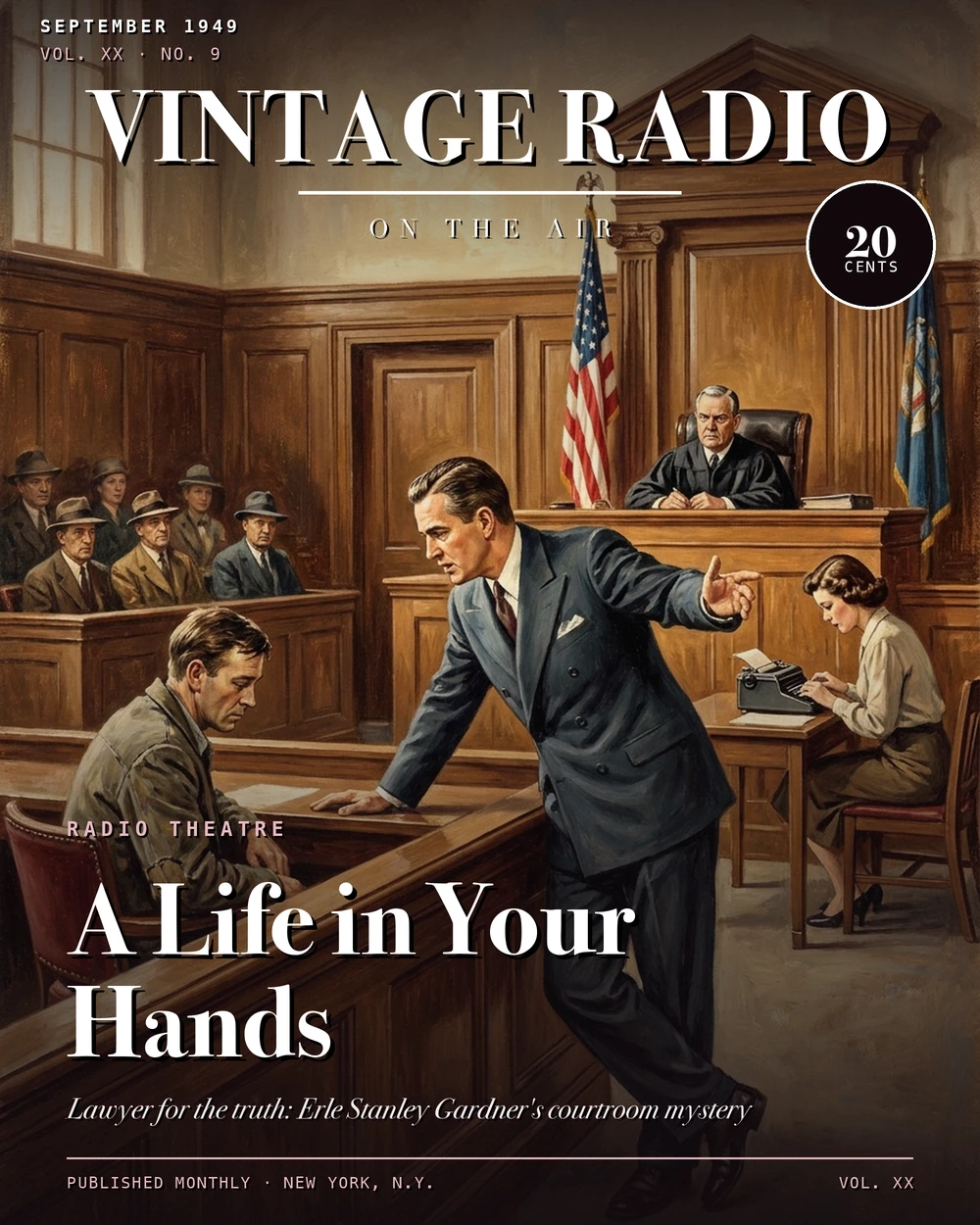
A Life in Your Hands
The Idea Behind the Show
Most radio crime dramas of the late 1940s and early 1950s followed a familiar pattern: a detective gathers clues, identifies a suspect, and delivers the guilty party to justice. A Life in Your Hands worked differently. The show placed its central character, Jonathan Kegg, in a courtroom as an amicus curiae — friend of the court — representing neither prosecution nor defense. Kegg's only client was the truth, and he was permitted to examine witnesses on both sides of a murder case to find it. That format invited listeners to weigh the evidence themselves rather than simply follow a hero to an answer, which set the show apart from nearly everything else on the dial.
The philosophical backbone came directly from Erle Stanley Gardner, credited as creator. Gardner — a California lawyer turned enormously prolific mystery novelist, and the best-selling American author of the 20th century at the time of his death in 1970 — had founded the real-life Court of Last Resort in the 1940s, a private organization dedicated to helping people imprisoned unfairly or unable to get a fair trial. He passed the California State Bar in 1911 and spent his early legal career defending impoverished clients, including Chinese and Mexican immigrants. That experience clearly shaped the Jonathan Kegg character: a wealthy lawyer who would never take a fee, working solely to establish what actually happened. Gardner's contribution to the show was largely his name and his ideals rather than his pen — the scripts came from writers including Bob McKee and Doug Johnson, and the show was guided through its four summer runs by a rotating group of producer-directors: Jack Simpson, Patrick Murphy, John Cowan, and Homer Heck, all working out of Chicago.
Four Summers, Two Networks
The series ran as a summer replacement from 1949 through 1952, never filling a full broadcast year. Its first two seasons aired on NBC, Tuesdays at 10:30 PM, stepping in for People Are Funny from June through September in 1949 and again in 1950, with Raleigh Cigarettes as sponsor. In 1951 the show moved to ABC for a Friday night slot at 9 PM, substituting for The Adventures of Ozzie and Harriet with Heinz Foods picking up the bill. The fourth and final run came back to NBC in the summer of 1952 — Thursdays at 8 PM — but without a sponsor. That sustained status was a signal the show was running out of road, and it ended August 21, 1952. Music across the run came from Adele Scott and Bernard "Whitey" Berquist, both part of the Chicago production apparatus that, along with both announcers, suggests the series was produced there throughout.
Three Actors, One Role
Jonathan Kegg was played by three different actors across the show's four runs — an unusual casting history for such a short-lived program. Ned LeFevre took the role in 1949. Carleton KaDell stepped in for 1950, returned for 1952, and handled narrating duties during those seasons, combining acting and announcing in a single chair. KaDell was an experienced radio figure with a long career that included playing Tarzan in the 1935 serial The Diamonds of Asher and nearly a decade as announcer on Amos 'N' Andy.
Lee Bowman played Kegg during the 1951 ABC run, bringing a substantial radio résumé that included Inner Sanctum and Cavalcade of America. His career extended well beyond radio: he had been the original choice to play Lucille Ball's husband in the July 1948 CBS audition pilot for My Favorite Husband before scheduling pushed Richard Denning into the part for the full series. In January 1951 — the same period as his A Life in Your Hands run — Bowman stepped in as the star of the ABC television series The Adventures of Ellery Queen, replacing the suddenly deceased Richard Hart. After leaving acting in 1968 he went on to a second career in corporate communications, serving as master of ceremonies for the 1968 and 1972 Republican national conventions.
The Announcers
The two announcers both went on to careers far exceeding their work here. Myron Wallace — later known as Mike Wallace — served as announcer around 1949, when he was a freelance Chicago radio personality working out of WMAQ-NBC. His other announcing credits at the time included Sky King, Curtain Time, and Road of Life, and that same year he made his first network television appearance as the lead in the ABC police drama Stand By for Crime, still billed as Myron Wallace.
Ken Nordine, the other announcer, was also Chicago-based and already building the reputation that would eventually make him one of the city's most recognized voices. He had started in radio in 1938 at WBEZ and worked at stations in Michigan and Florida before settling at WBBM-Chicago. He is best remembered for developing "word jazz" — spoken-word poetry improvised over jazz accompaniment — and hosted a weekly program in that form at WBEZ for over forty years. His deep baritone made him a first call for Chicago announcing work throughout the period he overlapped with A Life in Your Hands.
What Survives
Between 12 and 17 recordings survive across the four seasons, depending on which collector's catalog you consult, totaling somewhere between six and eight hours of audio. The premiere of June 7, 1949 — "The Final Curtain Call" — survives, as does what appears to be the final broadcast of that first NBC season. At least some 1952 episodes are also intact, including the opening installment of the final NBC run, in which Kegg encounters a murder case while vacationing on a quiet Caribbean island, and a July 24, 1952 episode involving an escaped murderer as the chief suspect.
The Great Detectives of Old Time Radio podcast called the series "a diamond in the rough" among Gardner's radio work — "forgotten" and "underrated" — and described it as "an interesting, stimulating, and educational mystery program that's well worth listening to for radio fans today." That assessment tracks with what made the show unusual: the courtroom format, the impartial protagonist, the invitation to the audience to form its own judgment. It was a quieter kind of crime drama, less interested in chases and confrontations than in the presentation of evidence and the question of what justice actually requires — which, for a show built around Gardner's Court of Last Resort ideals, was very much the point.